La Metafisica in questione. Orientamenti metafisici del Novecento a confronto
- Home
- Events and Communication
- Events
- Events Calendar
- La Metafisica in questione. Orientamenti metafisici del Novecento a confronto

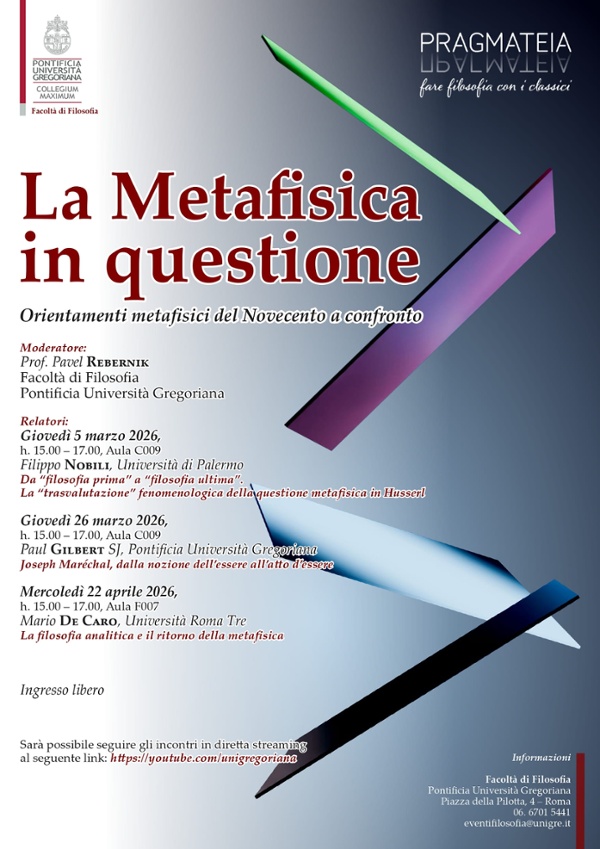
As part of the PRAGMATEIA philosophy workshop, and more specifically the history of metaphysical thought, the Faculty of Philosophy is launching a series of three lectures in which, through a critical comparison with classical authors of contemporary philosophy, three different “metaphysical orientations” of the twentieth century will be discussed, found respectively in phenomenology, the transcendental Thomism of Louvain, and analytical thought. In fact, beyond the repeated “proclamations” that accompany metaphysics in its historical unfolding, decreeing now its crisis, now its fulfilment, now its end, now its definitive overcoming, the radical nature of the metaphysical question continues to impose itself on reflection, allowing itself to be expressed in different forms and ways. With the help of three experts in Husserl’s phenomenology, Maréchal’s philosophy, and contemporary analytical thought, metaphysics will be taken up and discussed as a “question in itself”.
Filippo Nobili (Università di Palermo)
From “First Philosophy” to “Ultimate Philosophy”.
The Phenomenological “Revaluation” of the Metaphysical Question in Husserl
Far from representing an anti-metaphysical philosophy, Husserl’s phenomenological philosophy, in the course of its development, sets out an articulated path that leads to the idea of a “scientific metaphysics”, understood as “a definitive interpretation of reality based on the empirical sciences”. Understanding the scope of such a “material” and “a posteriori” metaphysics involves unravelling its relationship, on the one hand, with transcendental phenomenology and, on the other, with the positive sciences and their respective ontologies. Understanding Husserl’s idea of metaphysics as “ultimate philosophy” also means grasping the semantic shift that the notion undergoes, starting at least from its initial (pre-phenomenological) assumption as “first philosophy” – an assumption mediated by Brentano and of classical, Aristotelian ancestry. Finally, the novelty of Husserl’s metaphysical proposal can be appreciated by weighing up the teleological meaning of reason understood phenomenologically, considered in the entirety of its theoretical, practical and axiological articulation.
| Date: | Mar 5, 2026 |
| Hours: | From 15:00 To 17:00 |
| Organizer: | Faculty of Philosophy |
| Category: | Conference |
| Room: | C009 |
| Venue: | Pontificia Università Gregoriana |
Free admission until all seats are filled.
The conferences can also be followed via live streaming at the following link: https://www.youtube.com/unigregoriana