Cirillo e Metodio, missionari bizantini in territorio romano: evangelizzare in dialogo con i Papi
- Home
- Events and Communication
- Events
- Events Calendar
- Cirillo e Metodio, missionari bizantini in territorio romano: evangelizzare in dialogo con i Papi

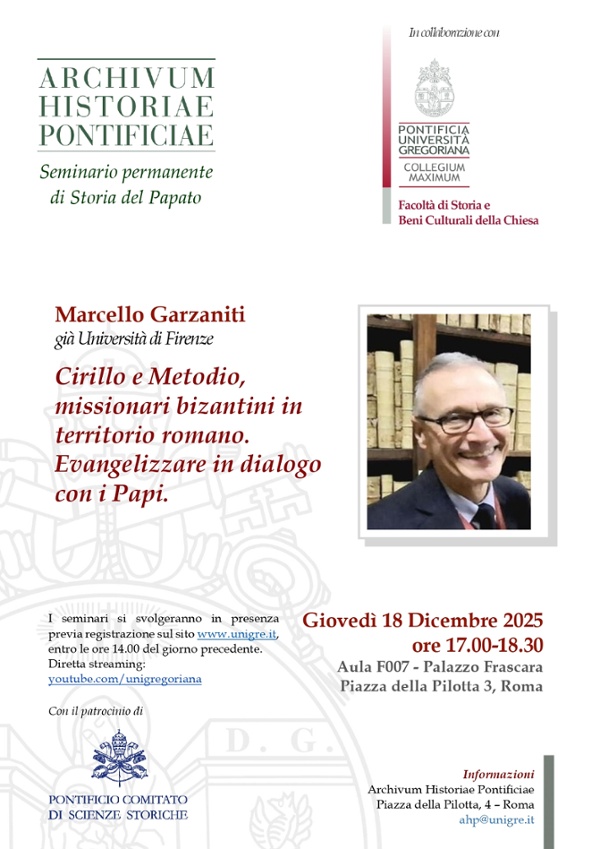
On Thursday, 18 December, at 5 p.m. in Room F007, the third session of the annual series of seminars on the History of the Papacy will be held. On this occasion, Marcello Garzaniti, former professor at the University of Florence, will give a lecture entitled “Cyril and Methodius, Byzantine missionaries in Roman territory. Evangelising in dialogue with the Popes”. The scholar will address the theme of Cyril and Methodius' mission, evaluating its significance beyond the question of the birth of the first Slavic language, which has been at the centre of historiography for the last two centuries. According to the scholar, in order to navigate the complexity of the Cyril-Methodius question and its legacy, one should start from a few fixed points, which are widely reflected in Slavic, Latin and Greek sources. The first is that the mission was conceived in Constantinople in the early 660s and produced a special alphabet for the Slavs, Glagolitic, and some translation samples. The second is that the mission took place in Pannonia and Moravia, a territory considered patrimony Petri in which Latin and Germanic missionaries were already active, but whose precise boundaries are difficult to define. The third factor concerns the transformation of the Byzantine mission into a Roman mission after the death of Cyril (869) and the election of Methodius as archbishop of Moravia on the initiative of Pope Adrian.
The work of Cyril and Methodius therefore began with the Slavic mission, prepared in Constantinople during the time of Patriarch Photius (863) and then passed under the aegis of Pope Adrian II (869). It took place in the heart of the European continent, where the interests of empires and various religious authorities clashed, while the Mediterranean basin appeared increasingly dominated by Islamic power, especially with the progressive conquest of Sicily (827-902). The lecture aims to emphasise the need to broaden the analysis of the context in which the mission began. It is important to consider not only papal and Germanic kingdom politics, as has tended to be the case, but also to study the extensive Byzantine influence and consider the outlines of its project, from the Khazar and Arab East to the Danube basin, where the conversion of the Slavs to Christianity would have played an important role in rebalancing the Germanic peoples' adherence to Western Christianity.
| Date: | Dec 18, 2025 |
| Hours: | From 17:00 To 18:30 |
| Organizer: |
AHP History and Cultural Heritage of the Church |
| Category: | Seminar |
| Room: | 007 - Frascara |
| Venue: | Pontificia Università Gregoriana |
Live streaming is planned.
The seminars will take place in person upon registration on the website www.unigre.it, by 2:00 p.m. on the previous day.
For information:
Archivum Historiae Pontificiae
ahp@unigre.it