CANTARE È PER TE ESISTERE
- Home
- Events and Communication
- Events
- Events Calendar
- CANTARE È PER TE ESISTERE

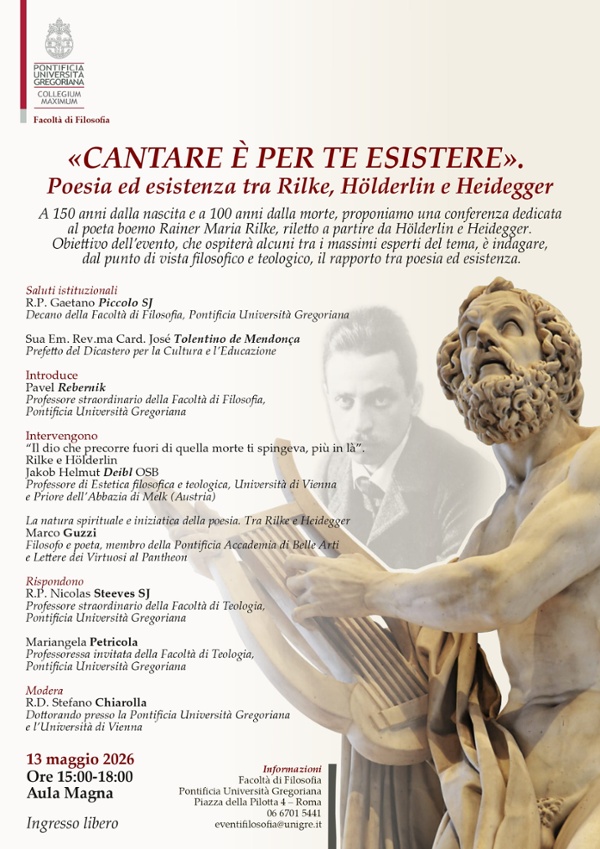
In his Letter on the Role of Literature in Education, Pope Francis invited us to rediscover the anthropological and religious depth of literature, the narrative unfolding of the spirit and “privileged access [...] to the heart of the human being” (no. 4). This revelatory dimension reaches its highest peaks in poetry, capable of “saying the unsayable” by retracing the adventurous intersections between the enchantment of words and the mystery of existence.
Philosophical and theological thought finds itself called to investigate the poetic phenomenon: what are the relationships between poetry and life? How does the absolute find a home in the hospitable womb of words? What dynamics make the poetic experience the privileged moment of listening to being and the surprising promise of a new contact with God?
Rainer Maria Rilke, whom Heidegger called “the guardian of the open in a time of poverty”, is a privileged interlocutor for answering these questions, as suggested by the double anniversary of his birth (1875) and death (1926). The work of the Bohemian poet, one of the highest expressions of Western lyric poetry, will be fruitfully illuminated by comparison with the poetry of Friedrich Hölderlin, tormented singer of nature and the divine, and by the masterful interpretation of Martin Heidegger, whose fiftieth anniversary of death (1975) also occurs this year.
Two exceptional guests will honour us with their presence: Prof. Marco Guzzi, philosopher and poet, member of the Pontifical Academy of Fine Arts and Letters of the Virtuosi al Pantheon; and Prof. Jakob Helmut Deibl, professor of aesthetics at the University of Vienna and Prior of Melk Abbey (Austria). Together with them, we will delve into Rilke's poetic-existential horizon, answering the question that the author himself posed in one of his poems: “To sing is for you to exist. An easy commitment to God. But we, when are we?” (Sonnets to Orpheus I, 3).
| Date: | May 13, 2026 |
| Hours: | From 15:00 To 18:00 |
| Organizer: | Faculty of Philosophy |
| Category: | Conference |
| Room: | Aula Magna |
| Venue: | Pontificia Università Gregoriana |
Free admission until full capacity is reached