
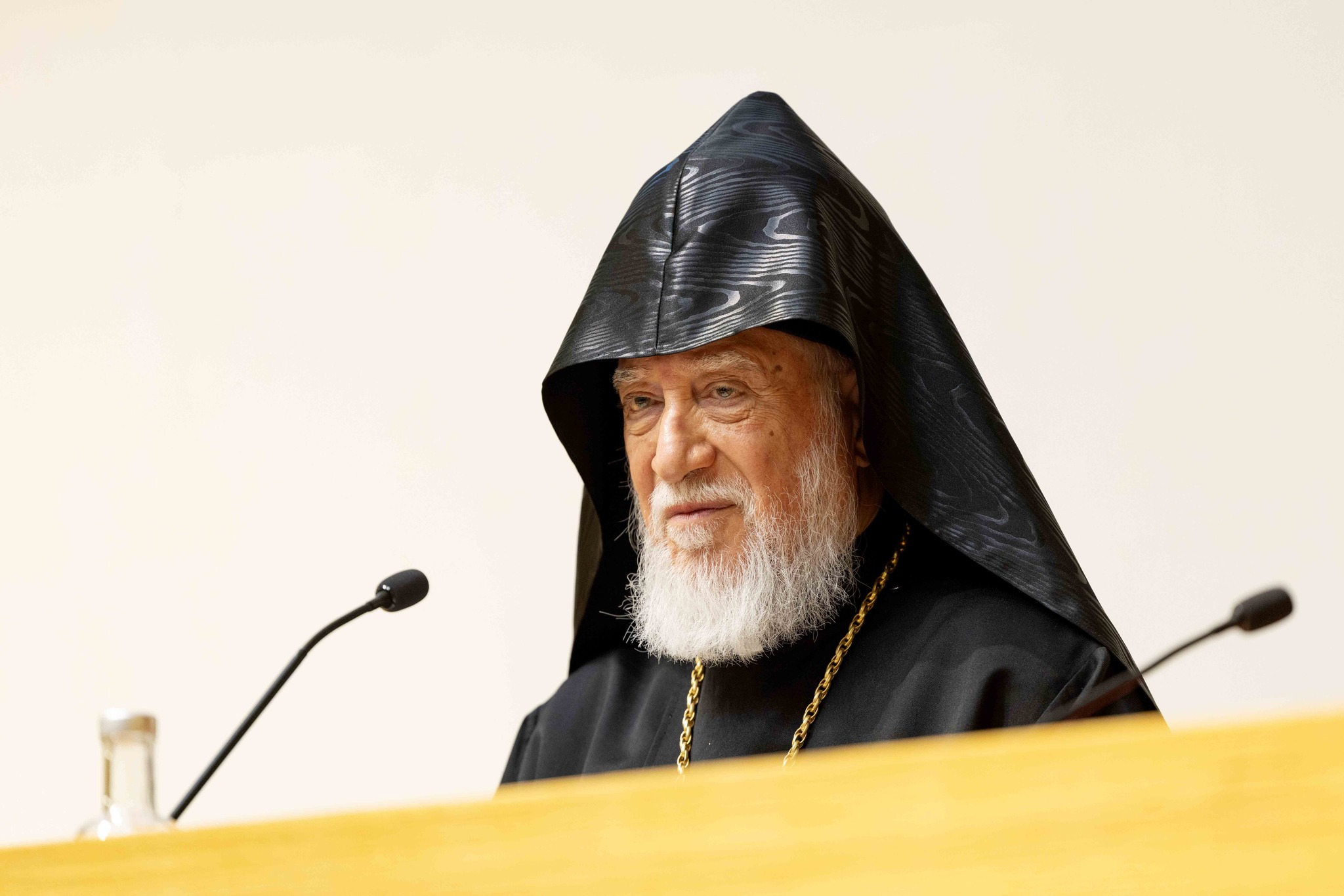
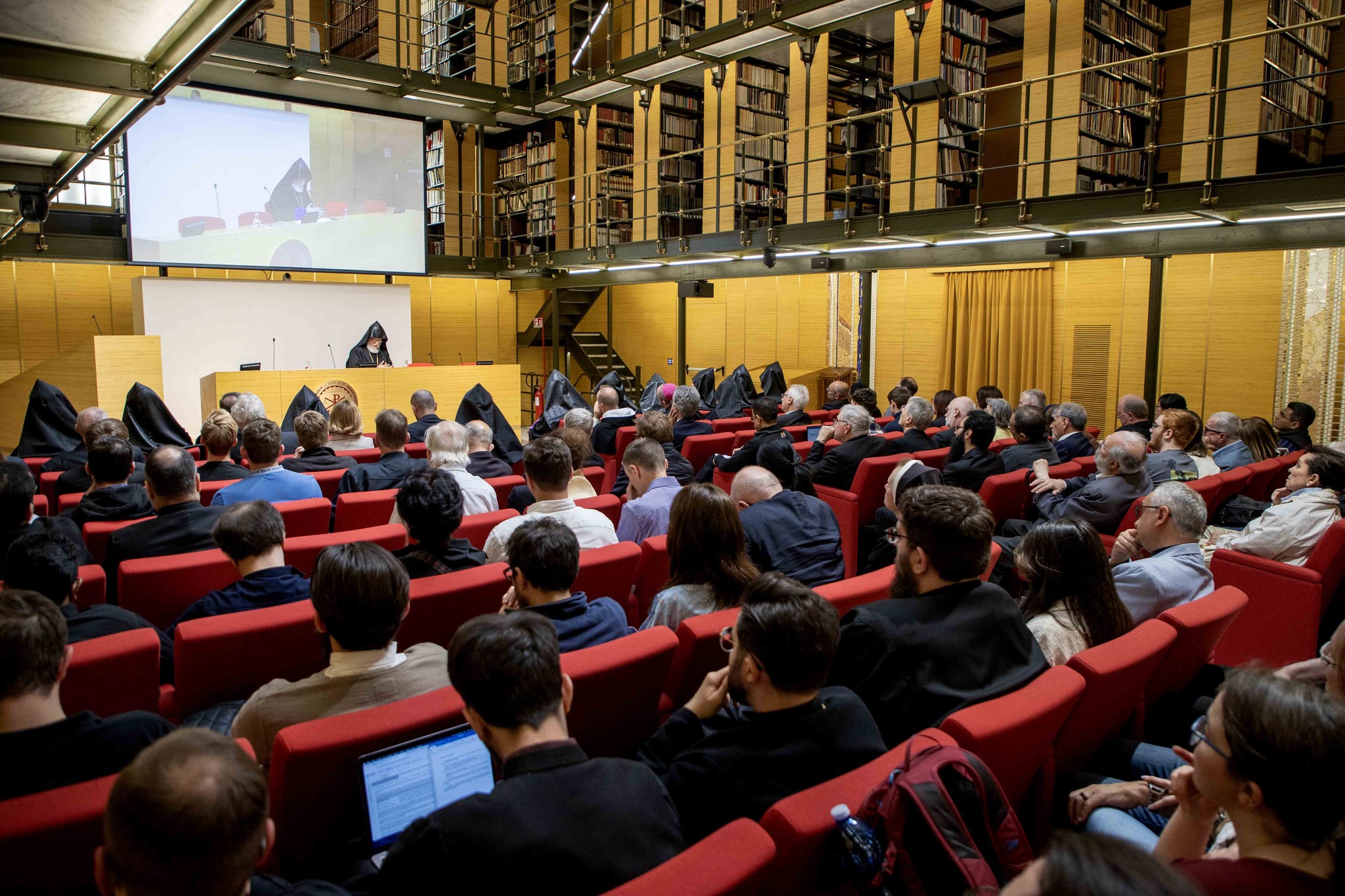
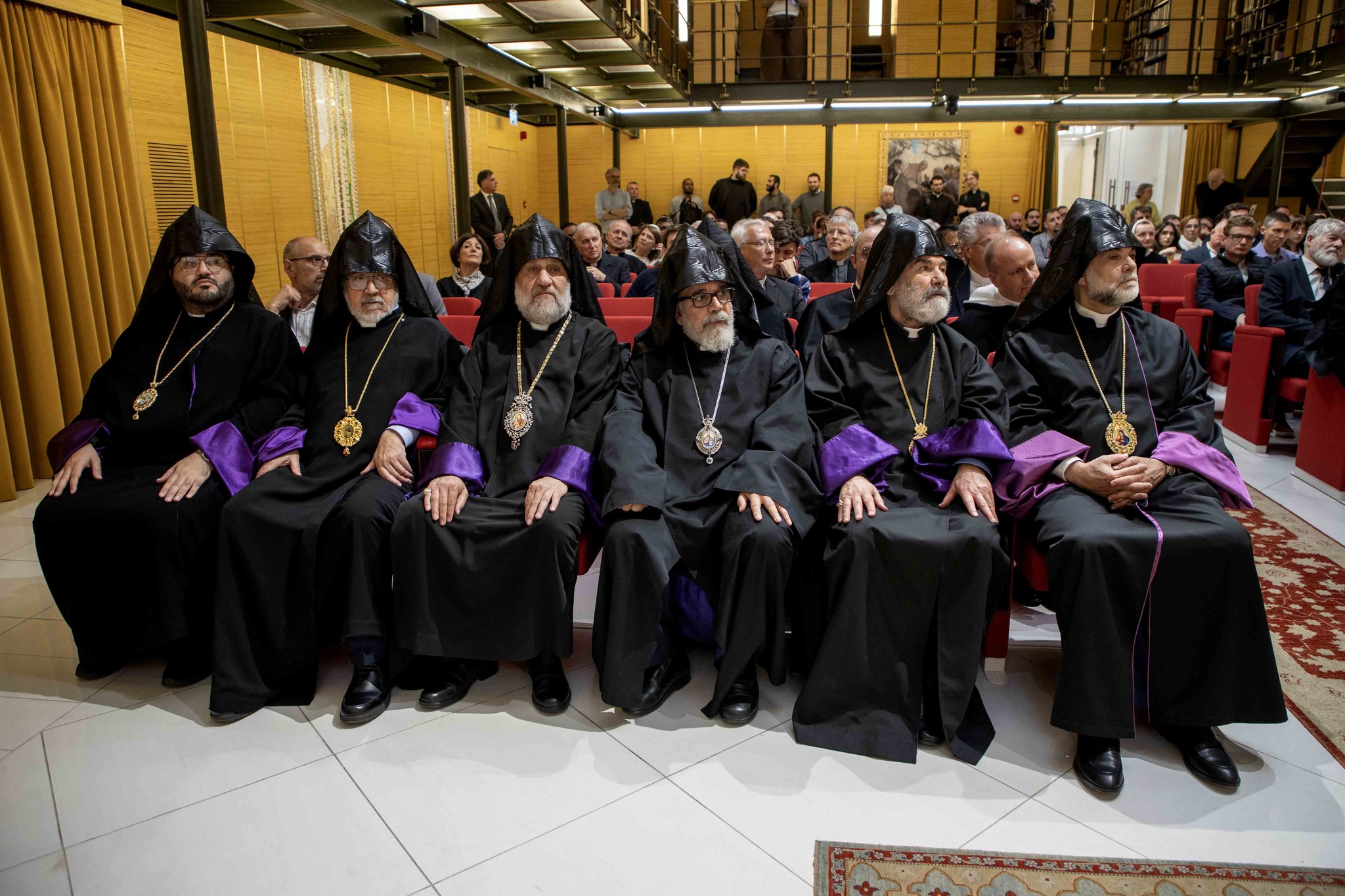
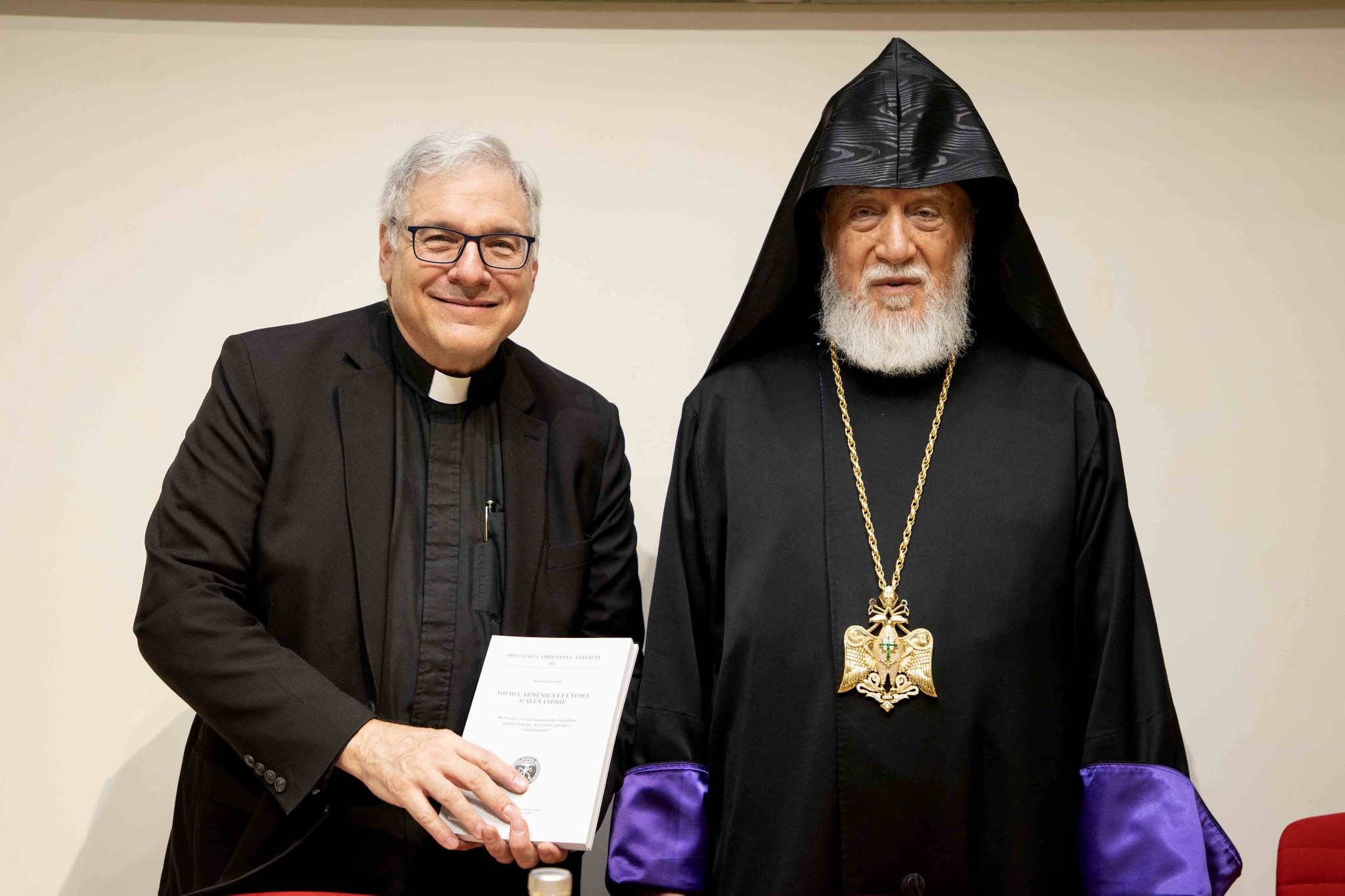
On Tuesday, May 19, 2026, His Holiness Aram I, Catholicos of the Armenian Apostolic Church of Cilicia - Holy See of Cilicia (Lebanon), gave a public lecture, "Challenges Facing the Churches in the Middle East," in the Aula Magna of the Pontifical Oriental Institute. The lecture was introduced by greetings from Father Sunny Kokkaravalayil SJ, President of the Pontifical Oriental Institute's mission, and Professor Marco Bais (Faculty of Oriental Ecclesiastical Sciences). At the conclusion of the lecture, the Rector of the Gregorian University, Father Mark Leiws SJ, and the Dean of the Faculty of Oriental Ecclesiastical Sciences, Father Željko Paša SJ, presented the Catholicos with several volumes from the "Orientalia Christiana Analecta" series. The text of the lecture by Catholicos Aram I is reproduced below.
Public Lecture of His Holiness Catholicos Aram I
The Churches of the Middle East
between Uncertainty, Despair, and Hope
At the crossroads of the modern history of the Middle East, the churches(1) of the region are wavering between uncertainty, despair, and hope. Uncertainty is increasingly deepening, despair is intensifying, and hope is dwindling away. I believe that this is the most appropriate way that one can objectively depict the current landscape of Christianity in the Middle East.
The history of the churches is inextricably linked to the history of the region, with all its complexities and uncertainties. The emerging geopolitical realities and their repercussions, with their far-reaching implications, are also impacting the Christian presence and witness in the region. The churches in the Middle East often refer, with some pride and self-confidence, to their glorious past, as well as to the region as the birthplace of Christianity and the shining centers of Christian civilization, which is true. However, actually Christian communities are more and more becoming shrinking minorities. An objective assessment of the present situation clearly indicates that the very future of Christianity is at stake in its birthplace. The reasons behind this alarming reality are multiple, stemming from historical factors, political developments, military upheavals, religious extremism, and economic crises.
It is beyond the scope of my presentation to address these factors and dynamics that continue to affect strongly the Christian presence, significantly reducing its numerical size, decreasing the efficiency of its witness, and marginalizing its role in various spheres of societal life. How can the churches cope with this disturbing reality? How can they respond to the challenges they confront as they bear witness to the Gospel values amid the turmoil of the Middle East?
Living in different politico–religious and socio-economic environments, Christian communities are facing different challenges and concerns. Specificities require contextual approach, while commonalities covering the whole region, entail different criteria. I will address two common and pertinent issues.
a) In the Middle East, Christians, whether organized communities or individuals, are highly respected as exemplary citizens, actively involved in multiple areas of society life, and often holding leading positions. I have witnessed with joy and pride, similar testimonies whenever I have met a political or religious leader. Freedom of conscience and worship are duly respected in all places. I do not share the deep-seated conviction of certain western circles that Christians are persecuted in the Middle East. However, I do share the concerns of those who claim that in some countries of the region, Christians are sometimes subject to various forms of discriminatory treatment, mainly related to the surge of Muslim fundamentalism.
It is a fact that obligations and rights of Christians pertaining to citizenship are, to a large degree, not respected, particularly in the political sphere. Lebanon is an exception. Each country has different approach to this issue. Ambiguity generates a number of questions and often compel the Christians to migrate. I do not believe that Christians are regarded as second-class citizens in the Middle East. However and rightly, Christians aspire to see the values of equal citizenship continuously strengthened in practice, so that all citizens, – regardless of religious affiliation – may fully enjoy the same rights, responsibilities, opportunities, and sense of belonging within their societies.
While many states in the region draw inspiration from Islamic traditions and values, they also possess civic and constitutional frameworks that can ensure inclusivity and equal participation. Within this context, constructive arrangements can be developed to safeguard the religious, educational, cultural, and legal particularities of Christian communities, while strengthening national unity and social cohesion.
b) Under the impact of economic crisis and unstable security conditions , Christians, particularly the youth emigrate to safer countries for economic opportunities. This intra-regional migration affect not only the integrity of the family life, but also the vitality of the community. However, the real problem is the migration of entire families to Western countries. In fact, every crisis, whether economic, security or political in nature, has always resulted in a huge way of migration of Christians and consequently a sharp decline in the Christian presence. Despite the continuous appeal of church leaders, the stark reality is that migration continues at an increasing pace. Monsignor Robert L. Stern, who has for served several years in the Middle East, reminds us that the region is the homeland of the three monotheistic religions, and then he adds.- "Jews feel at home in one part of it. Muslims feel at home in most of it. Increasingly, Christians do not feel at home at all". For some people, this analysis may be debatable. In my judgment, however, there is some truth in it and herein lies the crux of the problem which requires deeper and serious scrutiny. It is also a wake-up call for Christian communities. What are the alternatives?
The church should look at itself realistically and critically within the constantly changing context of the Middle East and, as far as possible, respond accordingly. The churches of the Middle East do not have a common strategy to grapple, in an organized, coherent, and consistent way, with the emerging geopolitical realities in the region and their repercussions to their communities. A common strategy implies a common vision. Christianity in the Middle East is like a boat wavering on a stormy sea with no clear direction. Uncertainty is causing despair, and even a crisis of survival. Church and Christian community leaders, should not leave their followers in an ambiguous and disoriented state. I know that there are no easy ways of dealing with crisis situations. However, I would venture to propose, out of my 50 years of pastoral experience in Lebanon, a few possible approaches.-
– Strong attachment to the homeland. Christians must remain firmly attached to the countries to which they belong. They are not strangers; they are born, formed, and raised in these countries which have become their homeland. Christians in Lebanon are Lebanese in the full sense of the word, in Syria, Syrians, in Egypt, Egyptian, and so forth, etc. It is therefore extremely important that Christians avoid, under any circumstances, giving their neighbors the impression that they are foreigners and unconcerned about the problems of the country in which they live. On the other hand, their Muslim neighbors should not question the patriotism of Christians, considering them as allies of Western powers because of their receptive attitudes towards Western values. Christians have always been regarded as bridges between East and West; a vital role that is imperative for the region.
– Re-building the community life. For the Christians of the Middle East, the church is not merely an institution; it is the community, expressing through its life and mission the togetherness of the people in all its dimensions, spheres, and manifestations. Nor is the church a historical relic of ancient traditions; it is a living and witnessing community. Hence, Christians should organize their life around the church, and the latter, with its responsibility to serve, lead, and facilitate, should become more active and engaged in all aspects of community life. The tendency to keep distance vis-à-vis the church, mainly for political and economic reasons, will not help neither to strengthen the sense of Christian belonging nor to reinforce the church's instrumental role as a unifying, and awareness and community building reality.
– Interaction between religious and national identities. Christians are caught in an existential tension between religious identity and national identity. How can they be an integral and inseparable part of the society to which they belong, while, at the same time, preserving their religious identity within a predominantly Muslim society? They cannot opt to one at the expense of the other. Creative and complementary interaction between the two identities is of crucial importance. The fact is that, to a large degree, Christian communities are arabized, except for the Armenian community, in terms of language, culture, and self-understanding. Arabization carries different connotations and perceptions. The concept of "l'église des arabes" (3) has, in the past, generated interesting discussions. It is important to note that the church remains a major and an essential factor in preserving identity. Ethnic languages, such as Syriac and Greek, as well as collective memory are still preserved mainly through the liturgy and culture of the church.
– Getting rid of minority-majority complex. There are different definitions, perceptions, and practices related to these concepts. I like to remind people that in Lebanon all communities, irrespective of their numerical size, are both minorities and majorities, because they have committed to living together. Minorities are perceived and treated differently across the countries of the region. In some countries, non-Muslims are regarded as minorities; in others as non citizens. Christian citizens should not be equated with foreigners and treated as minorities. On the other hand, Christians should not consider themselves as minorities, which may imply, at least psychologically, foreigners.
– Beyond dialogue to engagement. For decades Christian-Muslim dialogue has been an essential part of the agenda of our churches, as well as of Muslim institutions. Significant progress has been made in terms of deepening mutual understanding and affirming the need for collaboration in multiple areas of common life. Indeed, a growing emphasis on core values, shared traditions, and common concerns is important. Such initiatives should continue with renewed efforts. The challenge now is how Christians and Muslims can move beyond dialogue toward concrete engagement, both at the national and regional levels, by translating their common perspectives and shared values into common commitment?
– From being observers to becoming actors. The history of the Middle East reminds us that Christians have played a major part, including in leadership positions, in the political, national, ideological, cultural, social, and economic developments and movements of the region. However, successive crises, politico-military upheavals, resurgence of Muslim fundamentalism, and the decreasing socio-political role of Christians have increasingly marginalized them, compelling them to become rather observers and passive followers. I believe that Christians possess all the potential necessary to re-assume their active engagement at the forefront of societal life.
– From self-protective concern to proactive involvement A protective approach has always marked the Christian way of life. Christian communities have been defensive, mainly concerned with safeguarding their distinct identity. To this end, alongside to the church, they have built cultural, educational, social, and humanitarian institutions to protect the integrity and identity of the community. Over time, however, this self-protective strategy has led them pivot away from national interests and faces on community interests. Christian communities should realize that their concerns and expectations are closely associated with those of their Muslim neighbors. Therefore, they are called to move from self-protective ways of life, toward proactive involvement, particularly in addressing common challenges that require common response. Clearly, as an indivisible part of society, Christians should not avoid assuming their national responsibility as a concrete expression of their faithfulness to their homeland.
These are a few critical and pertinent issues that require deeper and more comprehensive discussion. The churches are also facing challenges pertaining to inter-church relations. I want to identify at least four areas of decisive importance.
1) Common celebration of Easter is a must. This is a common and urgent expectation among people of all walks of life. The issue is related to the two different liturgical calendars used by the churches: the Julian Calendar (Orthodox) and the Gregorian Calendar (Catholic and Protestant). Since the matter has no dogmatic implications, I believe that agreeing on a common date is achievable. Serious efforts have been made to this end by churches and ecumenical councils. I myself continue to raise this matter in my meetings with church leaders and at ecumenical gatherings. The common celebration of Easter will not only ensure more visibility to Christian presence in our region, it will also significantly contribute towards strengthening the unity of the church.
2) Mission is the raison d'être of the church. In fact, the church is reduced to a museum if it fails to articulate itself as a missionary reality. Crises call for re-activation of the missionary vocation of the church. Hence, the churches are urged to reshape a dynamic theology of mission that is impactful and responsive to the actual needs and expectations of the people. I consider education and diakonia as two vital dimensions of the church's missionary engagement. The churches have played a highly remarkable role in these areas. In fact, education, from elementary school to high school and university, from family education to Sunday school; and diakonia, from social action to health care, and from local dispensaries to hospitals have characterized the missionary outreach of the churches. In fact, with their quality and organizational efficacy, holistic approach and non-discriminatory spirit, the educational and diakonal actions of the churches have earned the admiration and respect of Muslims and even state officials. I believe that these two areas, which also help to strengthen Christian-Muslim coherent co-habitation, need to remain top priorities on the agenda of the churches.
3) Safeguarding their communities' ethnic, national, cultural, and even confessional identity and integrity has for decades overwhelmed the churches' pastoral and spiritual concerns, thus creating a gap between the church and the people. The bitter experience of the churches in the Ottoman Empire, marked by oppression, persecution, and genocide, has made the survival an existential priority. To this end, they have given priority to the institutional expressions and activities of the church. The churches are therefore called to reinvigorate their pastoral engagement. They should explore new models for grass roots-oriented pastoral ministry by efficient use of information and communication technologies.
4) My last point concerns awareness building sustained by advocacy and forward looking vision. I have endeavored with a realistic approach, to display the actual Christian landscape in its major aspects. I cannot predict the future of Christianity in the Middle East. However, the churches are urged to face uncertainty not with despair, but with hope because "hope does not disappoint" (Romans 5:5). As the churches continue, in faithfulness to their God-given calling, to carry on their witness, it is expected that.-
– Beyond dialogue, encounter, and collaboration, Christians and Muslims as co-citizens, sharing the same joy and pain, achievements and crises, seriously and responsibly commit themselves to nation-building.
– Political authorities challenge the prevailing perceptions in the West, that Christians in the Middle East are "marginalized" and "threatened", by providing to Christians with broader space and opportunities. Such a bold step will certainly strengthen Christians' attachment to their homeland.
– Western Christianity look at Middle Eastern Christianity not as remnants of the past, but as organized and active communities and bridge–builders between East and West, as well as among the monotheistic religions.
– Finally, it is expected that the world-wide diaspora communities of Middle Eastern churches, articulate more tangibly their responsibility towards their homelands and mother churches.
Footnotes
(1) With their rich diversity of confessions and traditions, the churches of the Middle East represent almost a miniature of the World Christendom.
(2) "Perspectives" in One, September 2010, p. 36.
(3) This concept has been extensively treated by Jean Corbon, L'Eglise des Arabes, 1977, Beirut. In the Middle East there also churches whose mother tongue is Armenian, Syriac, and Greek which, besides Arabic, are daily used by the members of these churches. Therefore, it is more appropriate to refer to them as Eastern Churches which covers all the churches of the region.
(All photos reproduced here are the property of the Catholicosate)