Idolatry is a term with a long and controversial history, having been applied rather vaguely to disparate religious phenomena, frequently as a pretext for intolerance and violence. In a literal sense, the word idolatry refers to the ritual worship (λατρεία) of an idol (εἴδωλον), i.e., an image or material object. Yet, historically speaking, it is in opposition to the notion of “true religion” that the term will surface as a category, coming to equate idols with false deities and idolatrous practices with false worship.
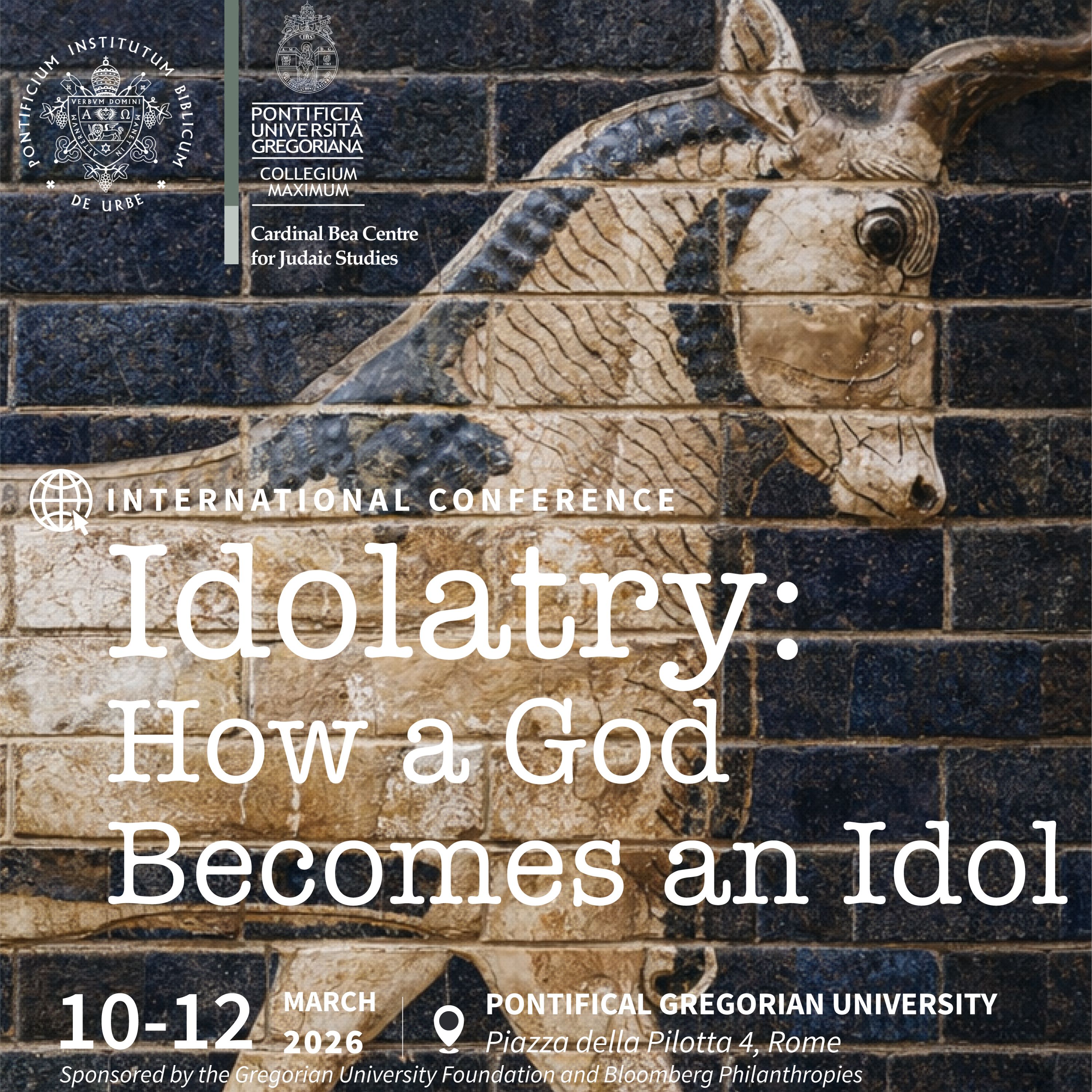
The international conference “Idolatry: How a God Becomes an Idol,” organized by the Pontifical Biblical Institute and the Cardinal Bea Centre for Judaic Studies of the Pontifical Gregorian University for March 10-12, 2026, aims to explore the emergence of the concepts of “false gods” and “mistaken worship.” How does a god become an idol? What rhetorical strategies allow authors and artists to deconstruct a god’s divine claim and portray it as inconsequential? When does worship become inappropriate or erroneous? What makes it blameworthy?
Guided by these questions, the conference will discuss the rhetoric and politics of “idolatrization” across a vast corpus of textual and visual sources ranging from the Iron Age to Late Antiquity, including Assyrian, Babylonian, Persian, Hellenistic and Roman Literature and Iconography, the Hebrew Bible, Early Jewish Writings and Mishnaic and Talmudic Literature, the New Testament and Early Christian Literature. The contributors will be asked to apply the outlined questions to the analysis of a particular text, corpus, image, or group of images while considering the historical context that gave rise to the polemics against idolatry.
- Participation is free and open to all.
- See the full Conference program
The academic event is sponsored by the Gregorian University Foundation and Bloomberg Philanthropies.